Most contractors don’t lose money because they price jobs too low on purpose.
They lose money because they don’t really know where the money goes.
Two jobs look similar on paper, but one makes a solid profit while the other barely breaks even. The estimate “felt right” on both. The crews “worked hard” on both. The customer was happy on both.
So why is one job a winner and the other a headache?
A big part of the answer is whether your estimating is built on units… or on vibes.
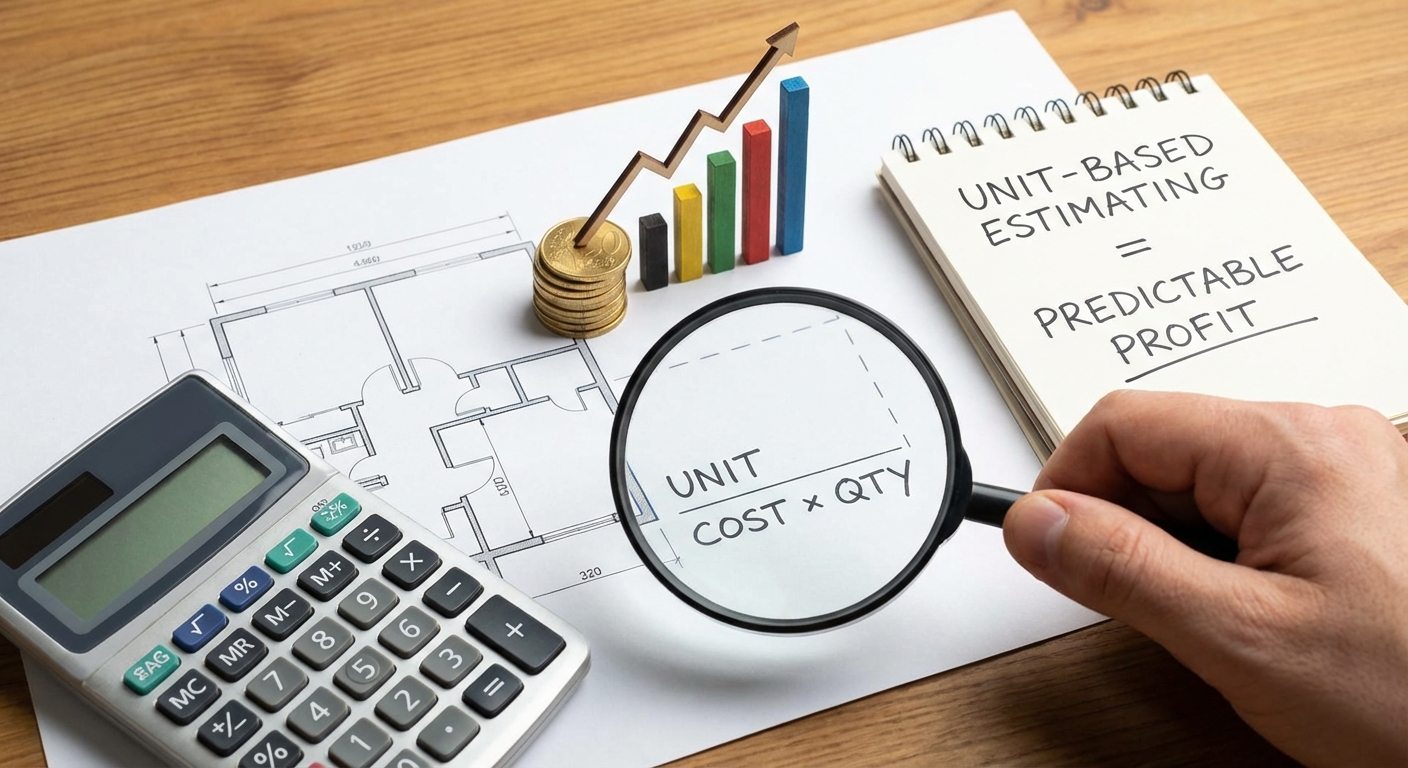
Unit-based estimating—the practice of pricing work based on measurable units (square feet, linear feet, openings, fixtures, etc.) with defined production rates—is one of the most powerful tools you can use to make profit predictable instead of mysterious.
And when it’s connected to how you actually run jobs day-to-day, it becomes more than a pricing method. It becomes the blueprint for your tasks, your time budgets, and your continuous improvement.
What Unit-Based Estimating Actually Is (and What It Isn’t)
At its core, unit-based estimating means:
- You break work into clear units: walls by square foot, trim by linear foot, doors by each, rooms by type.
- You assign standard production rates: hours per unit (or units per hour) based on real-world performance.
- You apply consistent pricing: labor and materials built from those units, not from a gut-feel lump sum.
Contrast that with the typical “experienced estimator” method:
- Scroll through photos.
- Think about “jobs like this we’ve done before.”
- Pick a number that feels safe.
- Round it up or down based on how busy you are and how much you like the client.
Experience matters. But without units, you can’t really:
- See which parts of the job are driving hours.
- Compare performance job to job.
- Adjust your pricing intelligently over time.
Unit-based estimating turns “one big guess” into dozens or hundreds of small, testable assumptions.
Why Unit-Based Estimating Makes Profit Predictable
When you build estimates out of units, a few powerful things happen:
-
Your labor budget stops being a blur.
Instead of “We think this is a 120-hour job,” you get:
— 40 hours for prep
— 50 hours for painting
— 30 hours for punch and touch-ups
each tied to specific quantities. -
You can job-cost with precision.
Actual hours can be compared against the units that drove them. If you’re consistently over on ceilings but under on walls, you know where to focus. -
You can adjust rates with confidence.
When a certain unit is always over hours, you can:
— Increase the production rate (more hours per unit), or
— Increase the price per unit to protect your margin. -
Training gets easier.
New estimators don’t have to “be you” to bid accurately. They just need to apply clear unit rates and understand where to tweak.
Unit-based estimating doesn’t magically make every job perfect. But it gives you a consistent starting point and a clear way to see where reality diverges from the plan.
Where Most Companies Go Wrong with Units
A lot of businesses try unit-based estimating and walk away disappointed. Common pitfalls include:
-
Using units for pricing but not for production.
The estimate is unit-based, but the job is handed to the crew as “go get it done.” The field never sees the structure that went into the number. -
Ignoring setup and complexity.
One rate for “walls” doesn’t work if you treat wide-open new construction the same as a chopped-up remodel with five colors. -
Not tracking actuals at the same level as the estimate.
If your actual time is just “80 hours total job labor,” you can’t compare it meaningfully to the unit breakdown.
The value of unit-based estimating isn’t just the math. It’s the way it can structure the entire lifecycle of a job—if you let it.
Turning Units into Tasks: Where the Real Leverage Is
The real magic happens when each unit in your estimate doesn’t just drive a price, but also drives a set of tasks.
For example:
-
1,200 sq ft of walls might generate:
— Protect floors and fixtures
— Patch and sand
— Prime
— Two finish coats
each with a slice of the total time budget. -
18 doors might generate:
— Remove and label
— Prep and sand
— Prime
— Finish coat 1
— Finish coat 2
— Reinstall and adjust
Now, instead of a job being “120 hours total,” it’s:
- A series of clearly defined tasks,
- Each tied to a portion of the hours from your unit-based estimate,
- Assigned to specific people or crews.
This does a few important things:
- Crews know what “done” looks like for each part of the job.
- Office staff can see where the job actually stands without driving to the site.
- You can see which tasks or phases consistently run over or under.
Suddenly, unit-based estimating is not just about the bid—it’s the backbone of your scheduling, your task lists, and your accountability.
Unit-Based Estimating as the Engine of Continuous Improvement
Once units drive tasks and tasks carry time budgets, you unlock a new level of visibility:
- You can see estimated vs. actual hours by unit, by phase, even by person.
- You can spot patterns, such as:
— “We’re strong on exterior trim, but always over on masking and prep.”
— “Crew A crushes ceilings; Crew B needs coaching there.” - You can experiment:
— Change a prep method on a subset of jobs and see if it moves the numbers.
— Adjust a unit rate and track whether margins stabilize without killing close rates.
Instead of arguing about whose memory is right, you have data that shows where you’re winning, where you’re leaking profit, and where a process change might actually help.
Unit-based estimating becomes your engine for continuous improvement—not just a better way to quote work, but a better way to run it.
Word From Our Sponsor (Yes, It’s WINWINI Again)
If you like the sound of unit-based estimating as the backbone of your business but don’t love the idea of wrestling it into spreadsheets and generic software, that’s where WINWINI comes in.
WINWINI takes unit-based estimates and uses them to auto-generate detailed task lists for each job, based on processes you’ve defined. Each task carries a time estimate and is tied to real units in the estimate, so you can see not just what each crew accomplished, but who did what, on which units, and how long it actually took.
Field teams see those tasks and phases on their phones, office staff and WINWINI providers work from the same desktop app, and owners get true estimated-vs-actual data—by unit, by phase, by person—not just a single “job total” at the end. The result is simple: unit-based estimating that doesn’t stop at the proposal, but runs all the way through your operations, powering predictable profit and genuine continuous improvement.