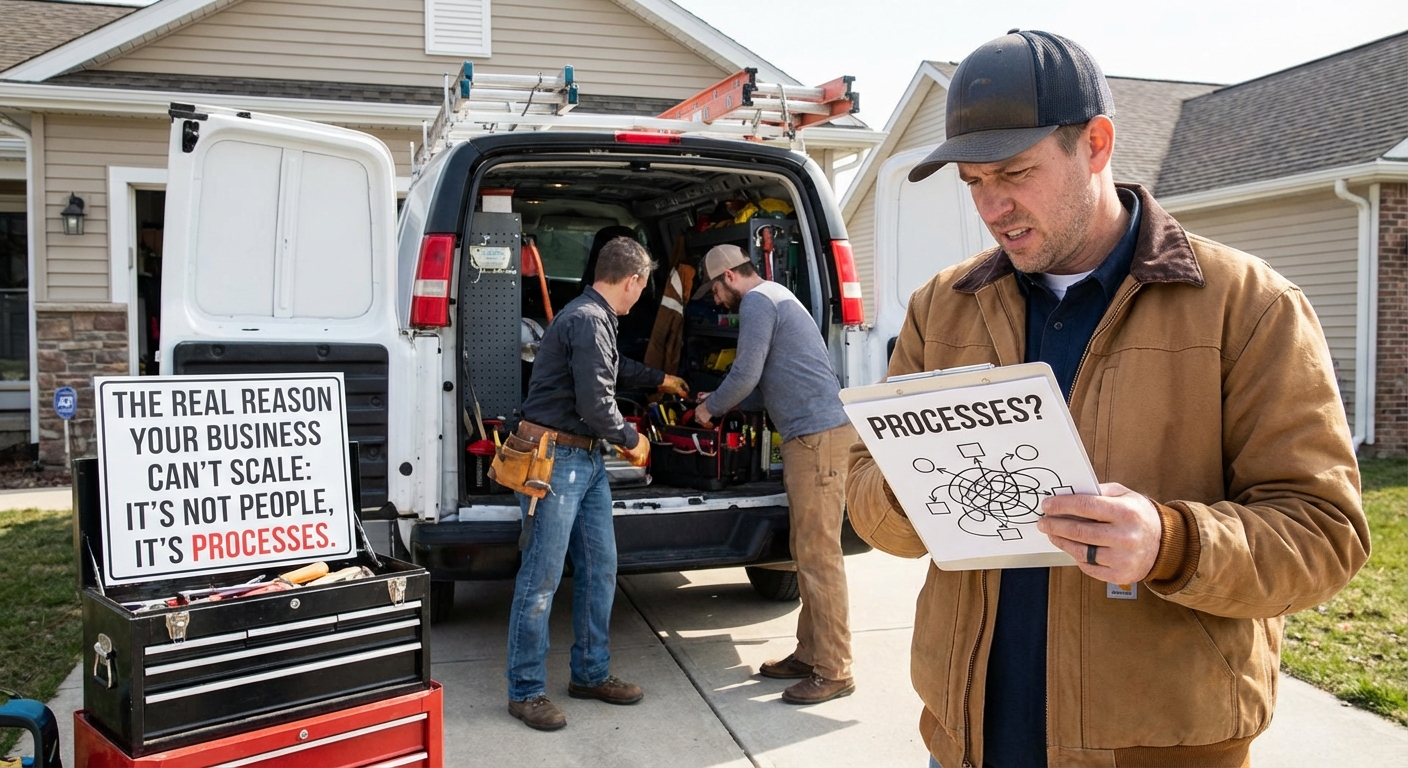
When a business struggles to grow, the first instinct is almost always the same:
- “We need better people.”
- “We just can’t find good help.”
- “If I had one more ‘me,’ we’d be unstoppable.”
But for most operations-heavy businesses—contractors, trades, home services—the real ceiling isn’t talent.
It’s process.
You don’t need superhuman people to scale. You need clear, durable ways of doing work so normal, solid people can succeed without you hovering over every job.
The “More People” Trap
When things get busy, adding people feels like the obvious solution:
- Another project manager to handle the load
- Another coordinator in the office
- Another crew leader in the field
For a little while, it seems to work. Then:
- You find yourself answering the same questions from more people.
- Mistakes multiply, but in new and exciting ways.
- You spend more time putting out fires and less time running the business.
What actually happened?
You scaled volume, not structure.
If your business runs on tribal knowledge, memory, and “how Sarah does it,” hiring more people just spreads the confusion around faster.
People Don’t Fail in a Vacuum—they Fail Inside Broken Systems
Most “people problems” are really process problems wearing a name tag.
When you look closely at a dropped ball, you usually find things like:
- No clear handoff between sales and production
- No standard way to set up or close out a job
- No defined steps for change orders, punch lists, or review requests
- No single place where tasks live and get checked off
The result:
- Office staff guess what needs to happen next.
- Field crews interpret vague instructions differently.
- The owner gets dragged in as the tie-breaker, every time.
Blaming people feels satisfying in the moment. Fixing processes actually changes the outcome.
You’re Not Scaling If Everything Still Runs Through You
Here’s a simple test for “scalability”:
Could you double your volume without doubling how many decisions you personally have to make?
If the answer is no, you’re not scaling—you’re just working harder.
Common signs:
- You review every estimate “just to be safe.”
- Every unusual customer request ends up on your phone.
- You are the only one who really knows “how we do things around here.”
That last one feels like strength, but it’s actually fragility. If the business can’t operate predictably without your brain, you don’t have a scalable model yet. You have a very busy job.
Processes are what let your standards survive contact with growth.
Processes Are Not Documents Sitting in a Folder
A lot of companies think “we have processes” because they have:
- A few dusty SOPs in Google Drive
- A handbook no one reads
- A “systems” folder built during a slow winter
Those are artifacts, not living processes.
A real process has three characteristics:
-
It’s clear.
People know the steps, in order, in enough detail to actually do the work. -
It’s visible.
The process shows up as tasks in someone’s day—not just as a paragraph in a document. -
It’s enforced and tracked.
You can see what was done, what wasn’t, and where it’s stuck.
If “the process” lives only in a document, it’s optional. If it lives in the actual task list people use to do their jobs, it’s real.
The Field Can’t Be Consistent If the Office Isn’t
Owners often try to “tighten up” the field with more rules:
- More checklists
- More photos
- More signatures
But if the office work is unstructured, the field will always be playing catch-up.
Think about what the field depends on:
- Accurate, timely job information
- Clear scope and expectations
- Materials and scheduling that match reality
- Confirmed access, color selections, and change orders
If those inputs are messy, no amount of “better people” in the field will fix it. You just get highly skilled crews executing bad information faster.
Scaling means structuring both:
- How work gets sold and set up
- How work gets executed and closed out
Not just tightening the screws on the last step.
Processes That Scale Are Built at the Task Level
You don’t scale by inventing big ideas. You scale by defining and repeating small, concrete actions.
For example:
Instead of:
“Sarah handles scheduling.”
You define:
- For every sold job:
- Create job in the system
- Confirm start date with customer
- Verify materials availability
- Assign crew and communicate arrival window
- Confirm access details (locks, gates, pets, parking)
Each of those becomes a task, owned by a specific role, tied to a job, with a due date.
Same in the field:
Instead of:
“Crew leader manages the job.”
You define:
- Job start checklist
- Daily start and end-of-day routines
- Phase-by-phase tasks (prep, prime, coats, punch)
- Photo and note requirements at key milestones
Scaling is just: more jobs, more of these defined tasks, handled by more people who don’t have to invent the process from scratch.
Why Processes Beat “Rockstar” Hiring in the Long Run
Rockstars are great—when you can find them, afford them, and keep them.
But building a scalable business on the assumption that every hire will be exceptional is a losing strategy.
Processes let you:
- Turn good people into consistently great performers
- Onboard new team members faster
- Reduce your dependence on any one person (including you)
- Make quality and customer experience less random
Strong processes don’t replace good people. They give good people a fair chance to succeed without superpowers.
Word From Our Sponsor (Yes, Still WINWINI)
If all of this sounds right but your brain is quietly saying, “I don’t have time to design, implement, and monitor all these processes,” that’s the gap WINWINI is designed to fill.
WINWINI is a tech-enabled service that helps owners turn “how I want things done” into thousands of small, trackable tasks that run through a shared system. Estimates, jobs, and office routines all generate task lists that live on real people’s screens: field teams see phases and tasks on their phones, office staff and WINWINI providers run their day from a desktop app, and owners get visibility into what’s actually happening—without acting as the central nerve center.
Under the hood, every client runs on their own private server and database, with processes designed, implemented, enforced, and tracked so that growth adds revenue, not chaos. The goal isn’t to replace your people—it’s to give them processes strong enough that your business can finally scale without cloning you.