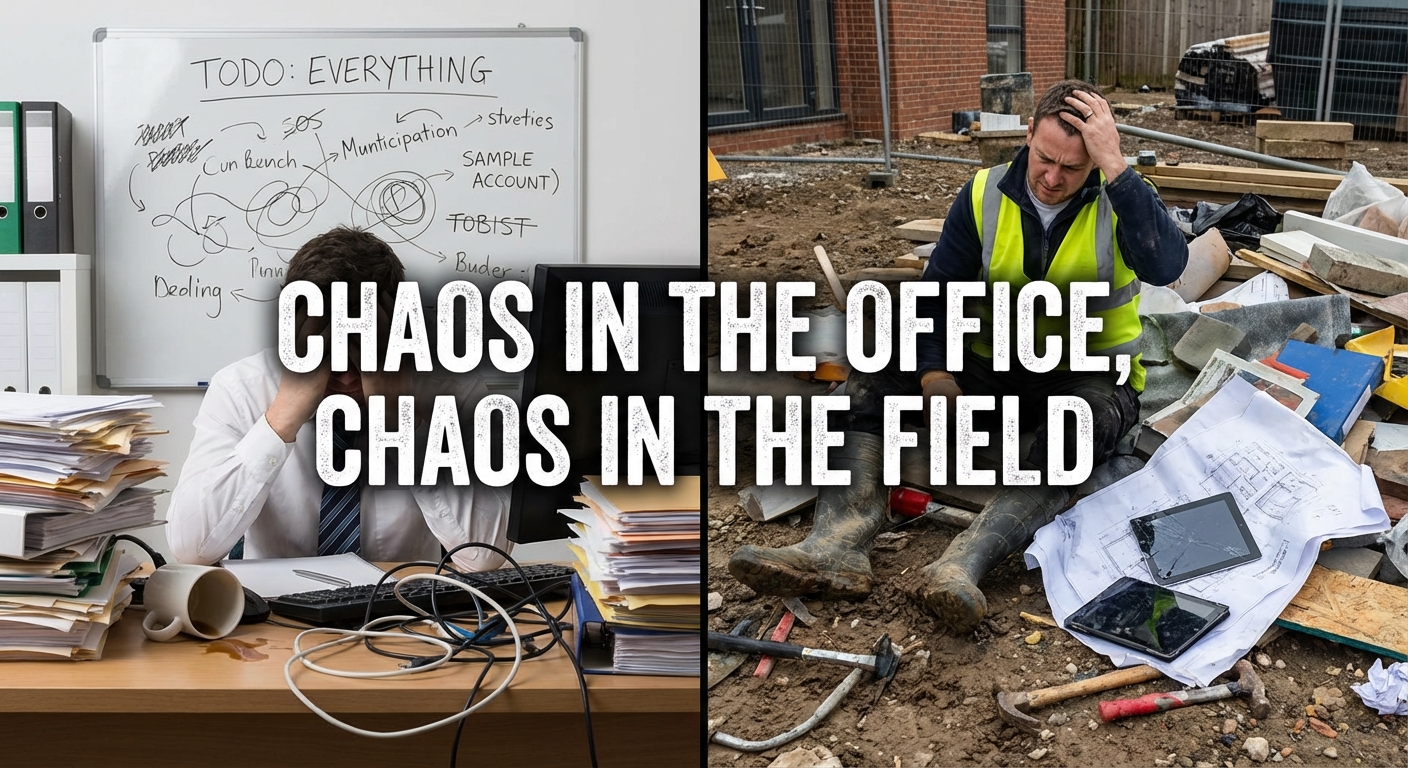
Most owners blame the field for chaos.
Crews run late. Materials get missed. Punch lists drag on. The instinctive story is: “If people would just do their jobs, we’d be fine.”
But in operations-heavy businesses—contractors, trades, home services—the chaos you see in the field usually starts somewhere else:
Unstructured work in the office.
When the office runs on memory, sticky notes, and inbox archaeology, the field never really gets a fair shot. The result isn’t just stress; it’s a slow, constant bleed of time, profit, and trust.
This isn’t about “being more organized” in a vague sense. It’s about recognizing the hidden cost of unstructured work—and why putting a structure around office and field tasks is one of the most profitable moves you can make.
When Everything Is “Someone’s Job,” Nothing Is Truly Owned
In most small businesses, responsibilities are clear only at the altitude of job titles:
- “Sarah handles scheduling.”
- “Mike does estimates.”
- “The crew leaders handle the jobs.”
But if you zoom in one level—to the actual flow of work—things get fuzzy:
- Who is responsible for confirming access to tomorrow’s jobs?
- Who checks that change orders make it into the schedule?
- Who sends review requests, and when?
- Who checks that time entries look reasonable before payroll?
What you really have isn’t a system; it’s a set of habits. And habits are fragile:
- They disappear when someone is out sick.
- They vary by person, mood, and workload.
- They don’t scale when you add more jobs, more people, or more locations.
Unstructured work relies on “good people doing their best.” Structured work relies on clear tasks with owners, timing, and a way to confirm they were actually done.
The first looks fine on a slow week. The second is what keeps you sane on a busy one.
The Field Always Pays for Office Chaos
Here’s the uncomfortable pattern that shows up again and again:
A small mistake in the office becomes a big problem in the field.
- A missed note on the work order → crew shows up without the right tools.
- A change order stuck in someone’s inbox → the customer expects more than what’s on the schedule.
- A forgotten material order → half the day is lost to supply house runs.
- A vague job description → the crew “finishes,” but the customer’s expectations were different.
From the office, these look like “little mix-ups.” From the field, they feel like constant sabotage.
And in the middle stands the owner, trying to patch it all together with last-minute calls and apologetic texts.
The financial cost shows up in:
- Extra trips
- Overtime
- Rework and callbacks
- Lost referrals and weak reviews
But the deeper cost is cultural: the slow erosion of trust between office and field.
Unstructured Work Keeps Everything Stuck in the Owner’s Head
In an unstructured environment, the owner’s brain becomes the real system of record.
You are the exception handler for everything:
- “Did we ever confirm that start date?”
- “What did the customer say about color changes?”
- “Are we waiting on a deposit before we order materials?”
The more the business grows, the more you are forced to:
- Remember details you should never have to remember
- Chase people for updates
- Re-explain decisions that were never recorded in a shared place
It feels like “leadership,” but it’s really a symptom: the business is running on you, not on a structure.
That’s why taking a vacation feels impossible. The chaos is not an accident; it’s the logical result of work that isn’t modeled, assigned, and tracked in a consistent way.
Structure Isn’t Bureaucracy—It’s Compassion
Many owners resist structure because they picture red tape and corporate nonsense. But good structure doesn’t slow people down; it actually makes their day easier.
Structure means:
For the office:
- Clear, recurring tasks instead of “remember everything.”
- A simple way to see what’s on your plate today, what’s waiting, and what’s late.
For the field:
- Work orders that actually reflect reality.
- Jobs broken into phases and tasks instead of “go make this go away.”
For the owner:
- Visibility instead of guesswork.
- The ability to ask, “Where is this job stuck?” and get an answer that isn’t a shrug.
Structure isn’t about controlling people; it’s about taking the burden of remembering everything off their shoulders.
What Structured Work Actually Looks Like
In practical terms, structured work means:
-
Jobs and customers are tied to tasks.
Every estimate, job, and change order automatically generates the office and field tasks needed to make it real. -
Tasks have clear owners and timing.
“Send review request” isn’t a vague good idea; it’s a task assigned to a specific person, due on a specific day. -
Field work is broken into phases and steps.
Instead of “Do the job,” crews see: “Protect surfaces → Prep → Prime → First coat → Second coat → Punch.” -
The same system connects office and field.
Notes, photos, and time entries live in one place, tied to the same job and tasks, instead of being scattered across apps. -
There’s a simple way to see what’s done and what’s not.
Someone can look—not ask, not guess—and see the status of today’s work, this week’s jobs, and this month’s priorities.
When you get even 60–70% of the way there, something surprising happens: chaos drops, not because people changed, but because the work did.
Word From Our Sponsor (Yes, That Would Be WINWINI)
If all this sounds great but you’re also thinking, “Who has time to build that kind of structure from scratch?”—that’s the exact gap WINWINI is designed to fill.
WINWINI is a tech-enabled service that maps your real-world work—leads, estimates, jobs, office routines—into thousands of small, trackable tasks. Office staff, providers, and field crews all work from the same system: field teams see phases and tasks on their phones, office teams run their day from a desktop app, and owners get a clear picture of what’s happening without living in their inbox.
Under the hood, every client runs on their own private server and database, with processes designed, implemented, enforced, and tracked so that “how you want things done” actually shows up in how work gets done. The goal isn’t to turn you into a software company—it’s to give you structured work instead of chaos, so your people can stop improvising systems and get back to doing great work.